
Prevention & Longevity
Echo2Go
Prevention & Longevity
A unique preventive health assessment designed by Echo2Go radiologists to provide a broad overview of your internal health in a single convenient session. This consultation is offered as a non-insured service (not covered by RAMQ) and is intended for individuals interested in proactive health and longevity seeking to maintain health and prevent disease.
Our whole-body preventive ultrasound is a proprietary Echo2Go protocol that provides a general overview of multiple organ systems. It is not a substitute for diagnostic testing and is intended for asymptomatic individuals seeking a proactive health review.
Duration: ~60 minutes
This service is provided directly by a board-certified radiologist – No other referral required
Includes a consultation, a “whole-body” ultrasound overview, and a structured multi-page report
Private, non-insured service – price: $1,799 (this service is a qualifying health-care supply and is exempt of GST/QST)
THE DAY OF THE EXAM
Your visit begins with a one-on-one consultation with the radiologist, who will carefully review your health questionnaire, discuss any current concerns, and perform a general health assessment to tailor a “whole-body” scan to your individual needs.
A prescription is therefore NOT required for this assessment.
A detailed color-coded easy-to-read multi-page report is then produced over the next 2-3 days and uploaded to your dedicated patient portal.
If any findings require more investigations or follow-ups, you will be referred back to your family doctor and offered a list of doctors/clinics you can consult in case you do not have an assigned doctor.
If a critical finding is found on your scan, you will be informed during your exam and our staff will make sure to refer you immediately to get the medical attention you need through our network of collaborating hospitals and doctors depending on the problem at hand.
Total exam duration: Approx. 60 minutes
No prescription required.
PRICING: 1799$
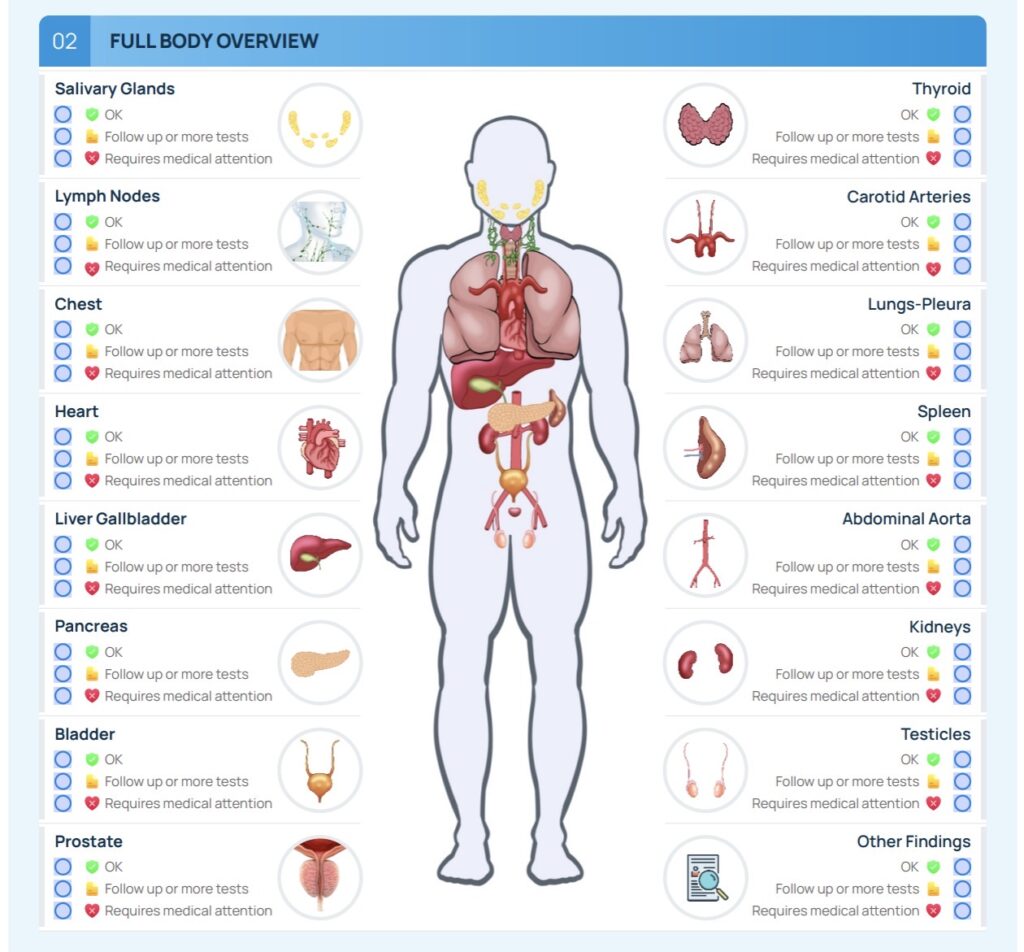
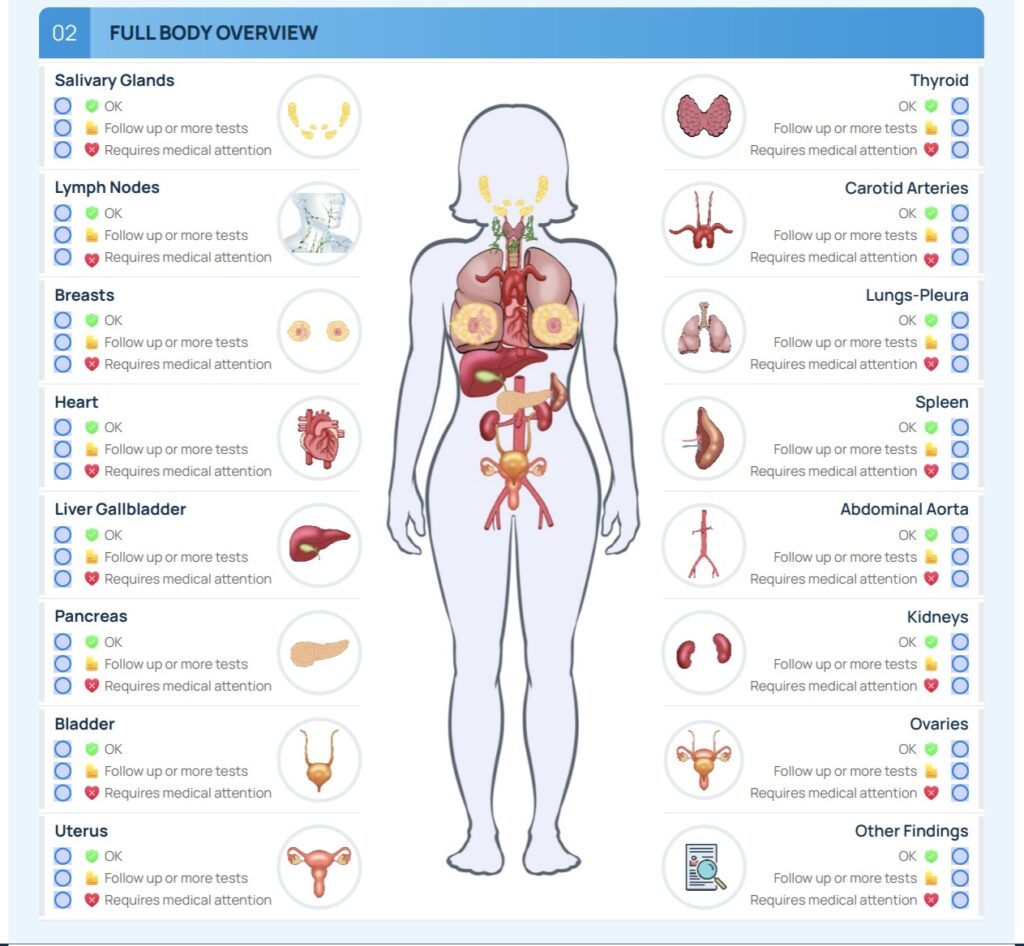
Structures and systems assessed include
- Heart (basic evaluation to assess for effusion and gross valvular disease)
- Abdominal Aorta (for aneurysm screening and plaque buildup)
- Lymph Nodes (cervical, abdominal, inguinal)
- Carotid Arteries doppler (STROKE risk screening)
- Breasts – Male and Female (NB. Not intended to investigate mammography anomalies)
- Lungs & pleura (thoracic cage masses, pleural effusions)
- Liver, bile ducts, Gallbladder (stones)
- Pancreas
- Spleen
- Kidneys
- Thyroid Gland / Neck
- Salivary Glands
- Bladder
- Uterus & Ovaries (for women)
- Prostate (for men)
- Testicles (for men)
- Other notable incidental findings (subcutaneous masses or other)
Additional Notes
Heart
This is not a full cardiac ultrasound. It is a basic cardiac evaluation to assess for effusion and gross valvular disease. – Consult the one-region ultrasound section for a full cardiac study (prescription required).
Breasts
This evaluation is NOT intended to investigate an anomaly already reported on your mammogram or to follow-up known breast lesions or cancers ongoing therapy.
Lungs & Pleura
Ultrasound assessment of the lungs and pleura is very limited and does not replace a chest X-ray or CT scan when indicated. Further imaging may be recommended based on clinical findings.
Uterus & Ovaries (for women)
The endovaginal evaluation is included in the price when deemed necessary.
Prostate (for men)
Ultrasound of the prostate cannot rule out cancer by itself and should not be a substitute for PSA testing or biopsy when indicated. Further evaluation may be recommended based on your risk factors and findings
Who can benefit?
Individuals with Multiple
Unexplained Symptoms
Those with Elevated Cardiovascular or
Metabolic Risk
- Diabetes or hypertension, which increase risk for kidney and vascular disease.
- Personal or family History of high cholesterol or carotid artery disease.
- Smoking history, increasing risk of aortic aneurysms and vascular pathology.
A whole-body scan allows evaluation of carotid arteries, kidneys, abdominal aorta, and more in a single session.
Adults Over 40
With age, the risk of silent vascular conditions, abdominal conditions and cancers increase. Subtle changes can begin in many organ systems, often without obvious symptoms.
A full-body ultrasound provides an opportunity to detect these issues early, when lifestyle changes or simple medical interventions can make the greatest difference.
- Fatty liver disease, kidney cysts, gallstones, or early pancreatic changes can be entirely silent but more common with age.
- Carotid artery narrowing and early vascular plaque can quietly progress, increasing stroke risk.
- Benign or concerning thyroid nodules become more frequent
- Prostate or uterine fibroid growth typically accelerates after 40, often without noticeable signs.
Proactive Patients
For patients who view their health as a long-term investment, guided by the desire to maintain control over their well-being and preferring to stay ahead of illness through a proactive approach
Patients with a Family History of Serious Conditions
- Aneurysms (such as abdominal aortic aneurysm)
- Cancers
- Cardiovascular or vascular disease Early ultrasound screening can help identify asymptomatic changes before complications arise.
Scientific Evidence Supporting
Whole-Body Ultrasound
Scientific Evidence Supporting Whole-Body Ultrasound
Radiation-free & cost-effective
Whole-body ultrasound offers real-time, radiation-free imaging (ZERO radiation), making it safe for repeated use—unlike CT and PET scans, which expose patients to ionizing radiation
Comfortable & quiet experience
Unlike whole-body MRI—which can be noisy, claustrophobic, and lengthy—ultrasound is fast and silent, making it ideal.
Targeted soft-tissue visualization
Ultrasound excels at imaging abdominal organs, pelvic structures, thyroid, lymph nodes, blood vessels, and superficial tissues—all covered in Echo2Go’s full-body screening
No requirement for contrast agents
CT and MRI often require contrast (iodine-based or gadolinium), which can pose allergy or kidney risks. Ultrasound does not involve any IV contrast injections.
On-site convenience
Studies note that ultrasound enables bedside or mobile-unit use, significantly increasing access while maintaining diagnostic accuracy
Key Comparisons
Feature
Radiation Exposure
Contrast Agents Required
Patient Comfort
Portability
Cost
Whole-Body Ultrasound
- None
- No
- Quiet, Open
- Mobile (comes to you)
- Affordable
CT/MRI
- CT/PET: ionizing; MRI: none
- Often MRI/CT require contrast
- MRI: Noisy, very confined
- MRI/CT: station-based only
- Usually $3000-6000
Key Comparisons
Feature
Radiation Exposure
Whole-Body Ultrasound
- None
CT/MRI
- CT/PET: ionizing; MRI: none
Contrast Agents Required
Whole-Body Ultrasound
- No
CT/MRI
- Often MRI/CT require contrast
Patient Comfort
Whole-Body Ultrasound
- Quiet, Open
CT/MRI
- MRI: Noisy, very confined
Portability
Whole-Body Ultrasound
- Mobile (comes to you)
CT/MRI
- MRI/CT: station-based only
Cost
Whole-Body Ultrasound
- Affordable
CT/MRI
- Usually $3000-6000
Unique Advantages of Whole-Body
Ultrasound vs MRI & CT
Dynamic, real-time assessments
Ultrasound isn’t just a static image — it allows dynamic, functional evaluations in real time, something MRI cannot replicate:
Examples of dynamic assessments we can perform with whole-body ultrasound:
Carotid Doppler flow
Measure real-time blood flow velocities, turbulence, and detect narrowing that increases stroke risk.
Heart contractility & valves
Watch your heart muscle contract and valves open/close in real time, assessing function instantly.
Respiratory pleura sliding
Observe the lung lining move with breathing — critical for spotting early signs of fluid or collapse.
Bladder filling & ureteric jets
Visualize urine entering the bladder from the kidneys live, helping detect obstructions.
Venous compressibility
Directly compress veins to rule out deep vein thrombosis (DVT) — a functional test not possible on static imaging.
Gallbladder wall changes with pressure
See if pushing the probe causes pain or wall thickening, indicating inflammation.
Reflux of venous flow on maneuver
Check for valvular incompetence in veins by having you perform maneuvers (Valsalva).